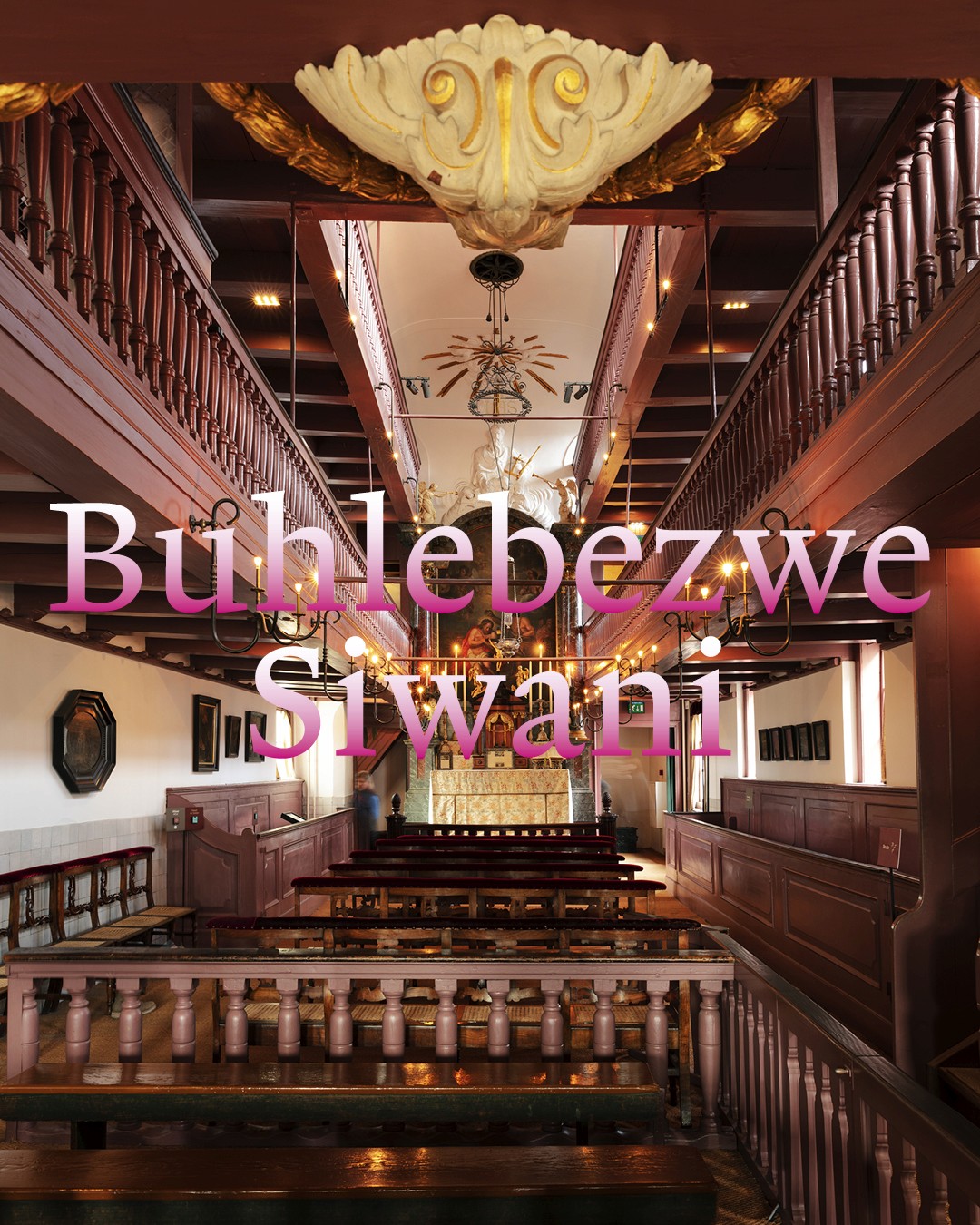
Museum Ons’ Lieve Heer op Solder
Buhlebezwe Siwani
Opening hours:
10:00 - 18:00
Address:
Oudezijds Voorburgwal 38-40
The histories of the Netherlands are visibly marked on Warmoesstraat. From the 13th century maritime trade shaped the street as a place for brothels and sex workers, a presence that expanded further in the nineteenth century. Around the corner lies Our Lord in the Attic Museum, a hidden church inaugurated in 1663, built inside a canal house attic when Catholics were forbidden from public practice.
Linked to the histories of the Red Light District and Catholic oppression, this work focuses on resilience and refuge. Through cycles of legalisation and criminalisation, both sex work and Catholicism have been alternately hidden and visible, yet neither has disappeared. The work presents portraits of people involved in both sex work and religion, showing how identities that appear incompatible can coexist.

Buhlebezwe Siwani is a South African artist and healer who works with performance, sculpture, photography, and installation. In her practice, she explores the relationship between body, spirituality, and history, and how colonial and Christian structures have displaced African knowledge and rituals.
Siwani often uses her own body as a starting point and connects indigenous spiritual practices with contemporary art. Her work approaches spirituality as a form of care, survival, and resistance, creating space for other ways of knowing and healing.
With a restrained, ritualistic visual language, Siwani invites the viewer to slow down and pay attention. This creates spaces where personal experience, collective memory, and political history converge.
About Location
Museum Ons’ Lieve Heer op Solder tells a quintessential Amsterdam story, hidden behind a seemingly ordinary canal house. High above the living rooms stands a complete church, built at a time when Catholics were not allowed to openly practice their faith. The museum shows how religion found a place in the city by adapting: not visible on the street, but very much present behind the facades.
This hidden church is about Dutch tolerance: there is room for difference, but within clear boundaries. Freedom exists, but is regulated; faith is allowed, as long as it remains private. Precisely this tension, between allowing and restricting, between visibility and concealment, remains at the heart of what's troubling in the Red Light District today.
What Ons’ Lieve Heer op Solder demonstrates is that discussions about sex, drugs, and tourism are not a new phenomenon, but part of a long urban history. For centuries, the Red Light District has been a place where the city has experimented with freedom, control, and pragmatic solutions. This museum makes it tangible that the same questions lie behind current debates as then: what is permissible, where is it permissible, and for whom?